The Well-Being and Mental Health Campus Collaborative was established in fall 2021 to advance the strategic plan goal of supporting holistic well-being and success of all students, faculty, and staff.
The initiatives described below were often led by Collaborative subcommittees and pursued in conjunction with campus partners.
Campus-Wide Website
Inventoried existing well-being and mental health programs, resources, training, and initiatives in each subcommittee area
Created Well-Being at Iowa website with listings for over 150 programs/resources and a custom filter tool for website users to conduct personalized searches
Launched and promoted website through campus-wide communication plan in fall 2024
Continued to update program/resources listings and other website content
89,000 +
1,725
166,475 lbs
Financial Well-Being Needs
Outlined funding plan for Food Pantry: In partnership with Center for Advancement, the Food Pantry held its first crowdfunding campaign through the University of Iowa GoldRUSH site, received gifts from private donors, and solicited donations from several businesses.
Piloted personal finance app: Division of Student Life staff piloted the You Need A Budget (YNAB) financial app for faculty and staff, then expanded to a larger pilot to general campus.
Teamed with Hills Bank on new services: The university partnered with Hills Bank to offer personal finance coaching, budget tools, and more to UI faculty and staff, including customers and non-customers.
Streamlined applications for student support: Applications for the Student Life Emergency Fund, Hawkeye Meal Share, and Graduation Support Program transitioned from Qualtrics to Workflow, improving response times, increasing collaboration with campus partners, and providing opportunities for improved assessment. Workflow data is housed more securely, allowing for all applications to be maintained internally and facilitating analysis of aggregated participant data.
Facilities Design and Construction
Iowa Memorial Union modernization: A question regarding experience with WELL Building and biophilic design was added to the request for proposals for the IMU Modernization Project. The responses to this question were a significant factor in the selection of a design firm.
Human-centered design: The Built and Natural Environment Subcommittee has seen success in implementing human-centered design principles into several large-scale projects including the IMU renovation, the Health Sciences Research Building, and the Iowa Advanced Technology Laboratory renovation and addition. Subcommitee co-chair Adele Vanarsdale has been instrumental in prioritizing inclusion of natural and wellness elements in these and other projects, and external partners have responded with enthusiasm.
Wellness Grants for facilities: liveWELL began awarding Wellness Grants to enhance existing indoor and outdoor campus environments, including features like respite spaces and campus community gardens.
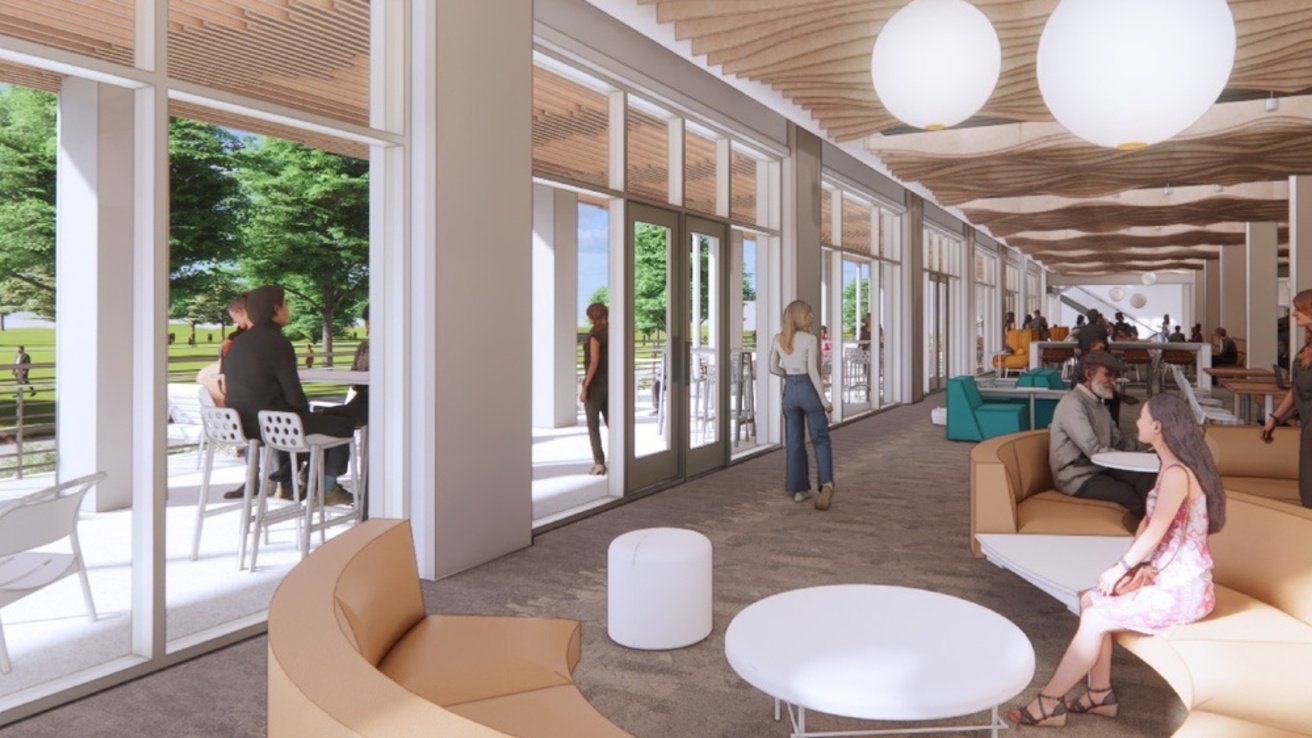
Rendering from the IMU Modernization Project

Respite space in the Ambulatory Surgery Center, supported by a Wellness Grant
Peer Support Programs
Support for faculty and staff: Peer support training and materials piloted for supervisors, staff, and faculty focus on identifying and assisting colleagues in distress. R U OK? can help supervisors and peers spot signs that someone may be struggling, prepare for a conversation about how they're doing, and provide appropriate referrals and follow up. Training continues to be implemented with units including the Division of Finance and Operations.
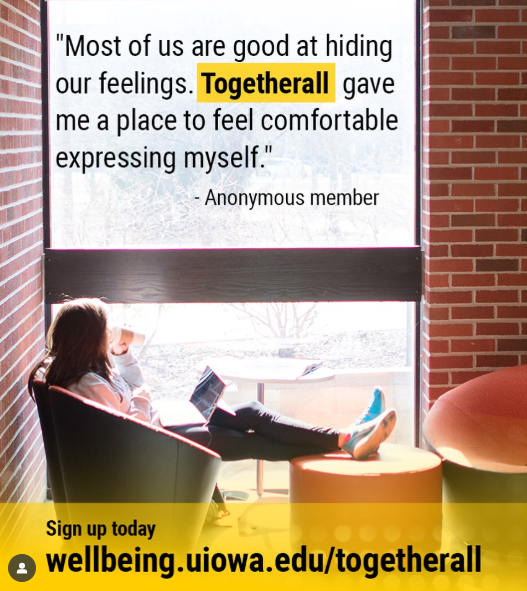
Support for students: Iowa students now have access to a clinically moderated peer mental health support resource. Through a collaboration with Togetherall, students can engage with a global community of peers, giving and receiving support in a safe and anonymous online environment.
Peer support clearinghouse: Peer support resources are inventoried, compiled, and shared on the Well-Being at Iowa website.
Coordinated Communication and Outreach
Common definition for well-being: Using feedback from multiple stakeholder groups, the current well-being definition was revised into an aspirational statement: Well-being at Iowa is fostered by an environment that promotes healthy and purposeful living for all campus members
5-for-5 Connection Challenge: Faculty, staff, and students were invited to commit to connect with people in their life five days in a row in February 2024 through the 5-for-5 Connection Challenge developed by the former U.S. Surgeon General to build and strengthen relationships and decrease loneliness.
Fall Into Wellness: A shared well-being communication challenge, Fall Into Wellness, was made available to all faculty, staff, and students. liveWELL and Student Wellness collaborated on this three-week challenge in fall 2024. Each day, participants pursued one goal from a variety of well-being topics, including mindfulness, stress management, connection, gratitude, exploration, movement, and rest.
ICON resources: ICON now features a “Well-being” navigation menu item, located on the left sidebar of ICON, just under “Help." It describes and links to a variety of well-being resources for students and faculty, including the UI Support and Crisis Line, Basic Needs, Student Health, University Counseling Service, and the Employee Assistance Program.
Shared teaching and communication resources: Teams created a Guide to Promoting Well-Being in the Classroom and a corresponding pressbook.
“I noticed a student who was tearful and struggling. I let him know that I saw him, I heard him, and I cared about him.”
47.5%
National College Health Assessment, 2025
88%
Working at Iowa Survey, 2025
Program Evaluation Improvements
Qualitative data collection: Qualitative data was collected to learn about supports for and barriers to well-being on campus. Teams conducted 14 student, faculty, and staff focus groups in Fall 2023 with students, staff, and faculty, and captured 68 student responses and 340 faculty and staff responses at listening posts during campus events. Key drivers of well-being identified from participants' experiences include:
Connection and belonging
Local-level campus support (instructor, supervisor, program, college)
Campus resources and awareness of resources
Flexibility and balance
Basic needs (financial, food insecurity, safety)
Mental health (resources, support, and response skills)
Workload (faculty and staff)
Feeling valued
Metrics dashboard: A high-level metrics dashboard provides Collaborative leadership with an overall view of well-being across identified metrics.
Common evaluation questions: liveWELL, Employee Assistance Program, and Student Wellness have implemented common program questions. A pilot demonstrated that questions worked across varied contexts for measurement of shared well-being goals and outcomes. The pilot expanded to include Recreation Services and the COPE team within UI Health Care.
Data visualization: Assessment leads implemented a custom IT solution to integrate data from the common evaluation questions into a comprehensive data visualization dashboard.
Mental Health and Crisis Resources
Supervisor training: Training programs on well-being and mental health in the workplace enrolled 707 supervisors during fiscal 2024 and 681 during fiscal 2025.
Policy clarification: In collaboration with the Staff Success SPARC group and Staff Council, language in the University of Iowa's policy on sick leave was edited to include mental illness as a way to prioritize employee well-being.
Crisis line: The UI Support and Crisis Line was expanded to faculty, staff, and postdocs.
Promoted resource guide: The Well-Being at Iowa site prominently displays the updated Resource Guide for Responding to Distress.
Mental health training for students: A new home-grown mental health awareness training is in its final stages of development to replace Kognito, which was phased out in May 2025. Modules will be called C.A.R.E.S.: Connect, Acknowledge, Respond, Engage, and Support – A Mental Health and Well-Being Series for Students. C.A.R.E.S. is an interactive role-play simulation in which students will learn about identifying when they and their peers are experiencing challenges, best practices for offering support to others, and how to make referrals to University Counseling Service. It will launch in Fall 2025 in CSI:1600 Success at Iowa, the required online course taken by all new first-year and transfer undergraduate students.
681
The training module equips supervisors with skills to recognize and address mental health challenges in the workplace
750+
In partnership with CommUnity Crisis Services in Iowa City, the University of Iowa provides around-the-clock mental health crisis and support for all students, faculty, staff, and postdocs